If you have spent any time researching alternatives to medication for focus, sleep, or anxiety, you have almost certainly come across the term neurofeedback. It sounds futuristic, and the explanations you find online tend to swing between two extremes. Some make it sound like science fiction, and others reduce it to something so simple that it loses all meaning. Neither version helps you decide whether it is worth your time.
This guide sits in the middle. Neurofeedback is a form of brain training that uses real time information about your brainwave activity to help your brain learn healthier patterns of self regulation. That is the short answer. The longer answer, which is what most people actually want, involves understanding what brainwaves are, what the equipment is doing, and why watching a screen can influence something as complex as your own nervous system. By the end of this article you will understand the mechanism, the realistic benefits, the current state of the evidence, and who tends to benefit most.
What Is Neurofeedback? A Simple Definition
Neurofeedback, sometimes called EEG biofeedback or neurotherapy, is a type of biofeedback that focuses specifically on the brain. Biofeedback in general works on a straightforward principle. When you can see a body process that is normally invisible to you, you can begin to influence it. People use biofeedback to lower their heart rate, relax tense muscles, and warm their hands by controlling blood flow. Neurofeedback applies that same idea to your brainwaves.
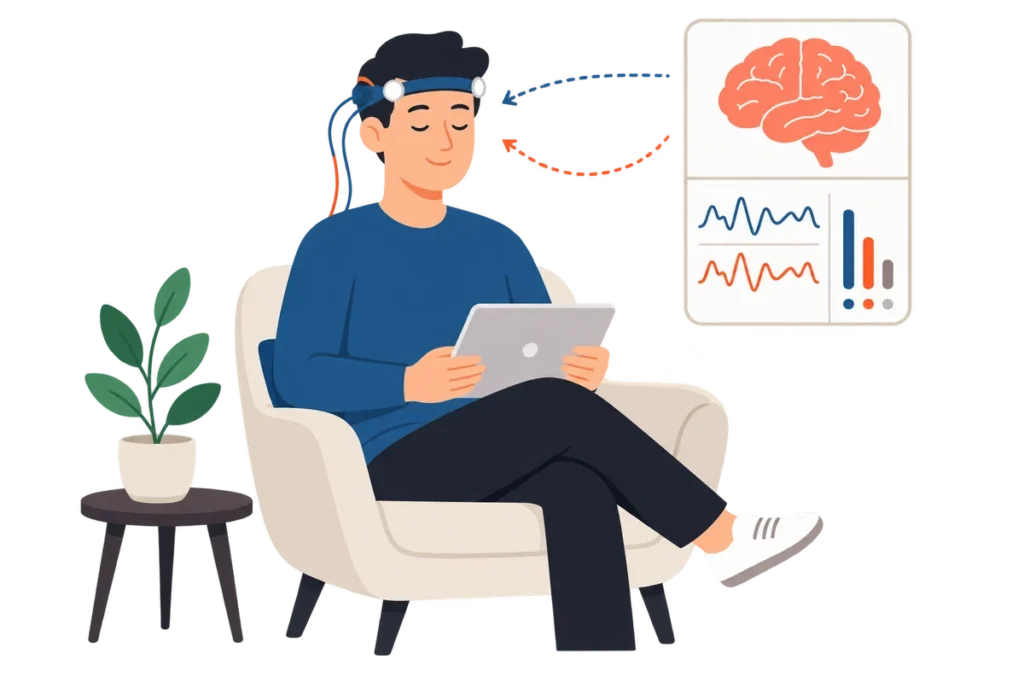
During a session, small sensors are placed on your scalp. These sensors do not send anything into your brain. They only listen. They read the tiny electrical signals your brain cells produce as they communicate with each other. Software translates that activity into something you can see or hear, usually a game, a video, or a simple visual display. When your brain produces the pattern the training is aiming for, the feedback rewards you. The video plays smoothly, the sound continues, or you earn points. When your brain drifts into a less helpful pattern, the reward quietly dims.
Over many repetitions, your brain notices the connection between its own activity and the reward. It gradually learns to spend more time in the target pattern. This is the same kind of learning that lets you improve at a sport or a musical instrument. You are not consciously deciding to change your brainwaves any more than you consciously decide how to balance on a bicycle. Your brain works it out through feedback and practice.
A Short History of the Idea
Neurofeedback is newer to the mainstream than many people assume it is old to research. Its roots reach back to the late 1960s, when scientists studying brainwaves discovered that animals—and eventually humans—could learn to change their own EEG activity when given real-time feedback about it. Early work explored training the sensorimotor rhythm, a specific brainwave associated with calm, focused stillness, and researchers observed unexpected benefits along the way. From those laboratory beginnings, the field grew steadily, and improvements in computing power turned what was once a clunky research tool into the smooth, game like experience clinics offer today. Understanding this history matters because it reminds you that neurofeedback is not a passing wellness trend. It is a decades old idea that has matured alongside our understanding of the brain.
Understanding Brainwaves: The Foundation of Neurofeedback
To understand how neurofeedback works, it helps to understand what it is actually measuring. Your brain contains billions of neurons that fire in rhythmic patterns. These rhythms, measured in cycles per second or hertz, are your brainwaves. Different frequencies are associated with different mental states, and a healthy brain shifts fluidly between them depending on what you are doing.
The Main Brainwave Frequencies
There are several well studied frequency bands, and each one tends to dominate during particular activities.
- Delta waves are the slowest, associated with deep, dreamless sleep and the body’s restorative processes.
- Theta waves appear during light sleep, deep relaxation, daydreaming, and the drowsy state just before you fall asleep.
- Alpha waves reflect a calm, relaxed but alert state, the kind of quiet focus you feel when you are settled and unbothered.
- Beta waves dominate active thinking, problem solving, and concentration, and higher beta can accompany stress or anxiety.
- Gamma waves are the fastest and are linked to high level information processing and moments of insight.
The goal of neurofeedback is rarely to make one wave good and another bad. The aim is balance and flexibility. A brain that produces too much slow wave activity when it should be alert may struggle with attention. A brain stuck in high beta may feel wired, anxious, or unable to switch off at night. Neurofeedback works toward teaching the brain to produce the right pattern at the right time, which is really a form of improved self regulation rather than a simple dial you turn up or down.
How Does Neurofeedback Actually Work?
This is the question that trips most people up, because the mechanism feels almost too subtle to be real. How can watching a video change your brain? The answer lies in a well established property of the brain called neuroplasticity.
Neuroplasticity and Operant Conditioning
Neuroplasticity is the brain’s lifelong ability to reorganize itself by forming new connections. Your brain is not a fixed piece of hardware. It is constantly reshaping itself in response to what you experience and repeat. Every skill you have ever learned exists because your brain physically adapted to support it.
Neurofeedback taps into this through a learning process called operant conditioning, which simply means learning through reward. When a behaviour is followed by something rewarding, it becomes more likely to happen again. In neurofeedback, the rewarded behaviour is a specific brainwave pattern. Because the feedback is instant, your brain receives hundreds of these tiny reward signals in a single session. Slowly, the target pattern becomes easier to produce and eventually more automatic.
The Role of the Brain Map
Good neurofeedback is not guesswork, and this is worth emphasising. Before training begins, most reputable clinics perform an assessment, often a quantitative EEG or brain map. This records your brainwave activity across many points on your scalp and compares it against normative data. The result shows where your patterns differ from what is typical for your age. That map is what turns neurofeedback from a generic experience into a targeted one, because it tells the clinician which areas and frequencies to train rather than applying a one size fits all protocol.
A Session, Step by Step
In practice, a training session is calm and undramatic. Sensors are placed on your scalp, you sit comfortably, and you watch or listen to the feedback. There is nothing to do in the effortful sense. You are not solving puzzles or straining to concentrate. Your brain does the learning below the level of conscious effort while you simply pay gentle attention. Sessions usually last between thirty and forty five minutes, and most protocols involve a course of sessions rather than a single visit, because durable change comes from repetition.
Why Watching a Screen Can Change Your Brain
The part that feels hardest to believe is that something so passive can produce real change. The key is that the feedback is faster and more precise than anything you could sense on your own. Your brain adjusts its activity constantly, but normally it has no way of knowing whether a given adjustment moved you toward a calmer, more balanced state. Neurofeedback closes that gap. It gives your brain a mirror, updated many times per second, so it can finally see the results of its own tiny experiments. Learning happens naturally when feedback is immediate, and neurofeedback simply makes an invisible process visible enough for your brain to learn from. You do not need to understand or even notice what is happening for the learning to take hold, in the same way a child learns to balance without being able to explain the physics of it.
What Can Neurofeedback Help With?
Neurofeedback has been studied for a wide range of concerns, and it is important to be honest about where the evidence is strong and where it is still emerging. It is not a cure all, and any provider who promises guaranteed results for every condition should be treated with caution.
Attention and Focus
Attention difficulties, including ADHD, are among the most researched applications of neurofeedback. A number of studies have found improvements in attention and impulse control, and some professional bodies have recognised it as a supported intervention. That said, results vary between individuals, and neurofeedback is best viewed as one option within a broader plan rather than a replacement for other proven approaches.
Sleep and Relaxation
Many people turn to neurofeedback because they cannot switch their minds off at night. Training that encourages calmer, more regulated activity can help some people fall asleep more easily and feel more rested. Because sleep and nervous system regulation are closely linked, improvements in one often support the other.
Anxiety and Stress
A brain that spends too much time in a high arousal state can leave you feeling permanently on edge. Neurofeedback that trains toward calmer patterns may help reduce that baseline tension for some people, teaching the nervous system that it does not need to stay in a constant state of alert.
Other Areas of Interest
Neurofeedback is also explored for concerns such as migraines, the aftereffects of concussion, and general peak performance for people who simply want sharper focus. The research quality in these areas is mixed, so the sensible position is cautious optimism rather than certainty. A responsible clinic will tell you honestly whether your particular goal is well supported by evidence.
Is Neurofeedback Safe, and Does the Science Hold Up?
Safety is one of the more reassuring aspects of neurofeedback. Because the sensors only read activity and never send electrical current into the brain, the process is non invasive and generally considered very low risk. Side effects, when they occur, tend to be mild and temporary, such as feeling tired or slightly headachy after a session, and they usually settle quickly.
When it comes to the science, the evidence is mixed, and it’s important to understand why. Neurofeedback has been studied for decades, and some applications have solid support while others rest on smaller or lower quality studies. Part of the challenge is that designing rigorous trials for a learning based therapy is difficult. Results also depend heavily on the skill of the clinician, the quality of the assessment, and how consistently the person completes their sessions. This is exactly why choosing an experienced, well qualified provider matters so much, and why realistic expectations are healthier than promises of a miracle.
Who Is a Good Candidate for Neurofeedback?
Neurofeedback tends to suit people who are looking for a non pharmaceutical option, who are willing to commit to a course of sessions, and who understand that change is gradual rather than instant. It appeals to parents seeking support for a child’s focus, to adults tired of feeling wired and unable to relax, and to people who have tried other approaches and want to address regulation at the level of the nervous system itself.
It is less suitable for anyone hoping for a single quick fix, because the whole method depends on repetition and learning over time. It is also not a substitute for medical or psychological care where those are needed. The best results usually come when neurofeedback forms part of a considered plan, guided by a professional who has assessed your individual brain patterns rather than applied a standard template.
How Neurofeedback Differs From Other Approaches
People often ask how neurofeedback fits alongside the more familiar options. It helps to see it as a distinct tool rather than a competitor to everything else, because it works on a different level.
Compared with medication, neurofeedback takes a different route entirely. Medication introduces a substance that changes brain chemistry for as long as it is in your system. Neurofeedback introduces no substance at all. Instead it aims to help the brain learn a pattern it can eventually hold on its own. Neither is automatically better, and for some people the two work well together, but they are not doing the same thing.
Compared with talk therapy, the difference is the entry point. Talk therapy works largely through language, insight, and conscious reflection, which is powerful for understanding thoughts and behaviour. Neurofeedback works beneath conscious thought, at the level of the nervous system’s raw regulation. Many people find the two complement each other, with neurofeedback settling the physical baseline so that the reflective work of therapy lands more easily.
Compared with general wellness habits such as exercise, good sleep, and mindfulness, neurofeedback is more targeted and more measurable. Those habits remain the foundation of a healthy brain and no amount of training replaces them. What neurofeedback adds is a precise, individualised focus on the specific patterns your own assessment reveals.
What to Look for in a Neurofeedback Provider
Because results depend so heavily on the quality of the clinician and the assessment, choosing the right provider is one of the most important decisions you will make. A few things separate a serious clinic from a superficial one.
- They begin with a proper assessment, such as a brain map, rather than starting training blind.
- They explain their approach in plain language and set realistic expectations instead of guaranteeing outcomes.
- They hold relevant qualifications and can describe their training and experience openly.
- They track your progress over time and adjust the protocol based on how you respond.
- They are honest about whether your particular goal is well supported by evidence.
If a provider promises a cure, refuses to discuss the mixed nature of the research, or skips assessment altogether, treat that as a warning sign. The most trustworthy clinics are comfortable with nuance, because that is where the real science of neurofeedback lives.
Frequently Asked Questions About Neurofeedback
The Takeaway
Neurofeedback is neither science fiction nor snake oil. It is a non invasive brain training method that uses real time feedback to help your brain learn healthier, more flexible patterns of self regulation. It rests on the well established science of neuroplasticity, it is generally very safe, and it has meaningful support for certain concerns while remaining more exploratory for others.
If you are curious about whether neurofeedback could help with your focus, sleep, or sense of calm, the most useful next step is a proper assessment. A brain map and a conversation with an experienced clinician will tell you far more about your own situation than any general article can, because your brain, like everyone’s, has its own unique pattern worth understanding.