
Important update: New enrollments will be $530/month starting June 10. Existing clients stay at $430/month.
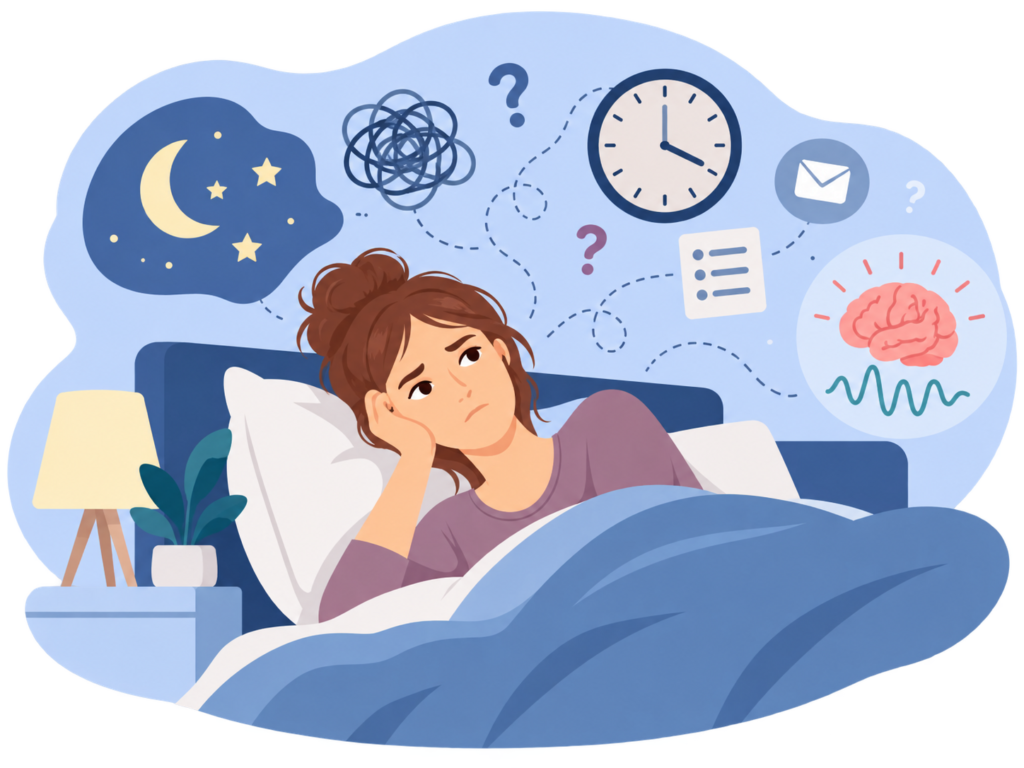
It is 11:40pm. You did everything right. No caffeine after two. Phone in the other room. Lavender something. You are genuinely, physically exhausted, and you have been looking forward to this moment since about 3pm.
You get into bed. And your brain wakes up.
Not slowly. Immediately. It starts with something small, like a work email you should have answered, and within four minutes you are rehearsing a conversation from 2019, planning a grocery list, and wondering whether that mole on your arm has always been that shape.
If this is your nightly routine, you already know the frustrating part. It is not that you are not tired. It is that being tired and being able to fall asleep turn out to be two completely different things.
Sleep is not something you do. It is something your nervous system permits.
Falling asleep requires your brain to hand over control, and it will only do that when it reads the environment as safe and the internal state as settled. That handover involves a fairly specific sequence: alert fast-wave activity has to come down, slower rhythms have to come up, and the arousal system has to stand down.
When that sequence runs properly, you do not notice it at all. You are lying there thinking about nothing much and then it is morning.
When it does not run properly, you get the experience you know so well. Your body is heavy and done. Your brain is still generating fast, alert electrical activity as though something important is about to happen. The two are out of sync, and you are stuck in the gap between them, which is one of the more maddening places to spend an hour.
Here is the cruel design flaw. Trying harder to sleep makes falling asleep less likely.
The moment you start monitoring your progress toward sleep, you have engaged the alert, evaluating part of your brain. You are now performing a task, and performing a task is the opposite of what is required. Add the clock math, where you calculate that you now have five hours and twenty minutes left if you fall asleep right now, and you have introduced mild time pressure into a process that only works in the absence of pressure.
This is why sleep hygiene advice, while genuinely worth following, has a ceiling. Blackout curtains and a consistent bedtime create the right conditions. They do not teach a dysregulated brain how to change gears.
Sleep problems usually look like one of a few distinct patterns, and they are not the same problem.
You lie down and mental activity increases. This is the classic racing-thoughts presentation. In EEG terms it often looks like excess fast-wave activity persisting when it should be declining, sometimes with the brain effectively stuck in a working state.
People with this pattern frequently say the same thing: this is the first time all day nobody has needed anything from me, so my brain finally has room to process everything. Which is exactly right. The processing was always there. You were just too busy to hear it.
You fall asleep fine and then surface at 2 or 3am, fully alert, often with a jolt of something that feels like dread before there is even a thought attached to it.
That feeling-before-the-thought ordering is a clue. This pattern is usually about arousal regulation rather than mental content. Cortisol naturally begins rising in the second half of the night in preparation for morning. In a well-regulated system that rise happens quietly underneath sleep. In a dysregulated one it can be enough to tip you into wakefulness, and then your brain, being helpful, supplies something to worry about to explain the alarm you are already feeling.
You get eight hours and wake up feeling like you got four. Nothing seems wrong with the duration, which is why this one often goes unaddressed for years.
Sleep quality depends on getting enough of the right stages in the right proportions. A brain that never fully settles can spend the night in lighter sleep, technically asleep but not doing the deep restorative work. The hours are on the board. The recovery is not.
Whichever pattern you recognize, the same loop tends to form.
Poor sleep degrades your ability to regulate emotion and attention the next day. That makes the day more stressful and your reactions bigger. Higher stress load means more arousal in the evening. More evening arousal means worse sleep. Around it goes.
This is also where sleep and mood start to tangle, and it becomes genuinely difficult to tell which one is causing which. We unpacked that in detail in our article on the sleep and depression cycle, which is worth reading if your low mood and your bad nights arrived together.
There is a modern-life layer on top of this too. Constant input, notification-driven attention switching, and never quite finishing anything all keep the nervous system in a low-grade activated state that it never fully exits. Our piece on why your brain was not built for this much noise covers that ground.
If you want the full picture of the method itself, read our explainer on what neurofeedback is and how it actually works. Here is how it applies specifically to sleep.
The training does not happen at night. It happens during the day, and the target is not sleep itself but the underlying flexibility that sleep depends on.
Sensors read your brain activity in real time. The system watches for the specific patterns your brain map identified. When your brain produces activity closer to the target state, the feedback responds. When it drifts, the feedback dips. Repeat that a few hundred times per session, several times per week, and the brain starts learning to find that state more easily.
The relevant skill for sleep is downshifting: the ability to move out of high-alert processing into a calmer state on demand. If your brain can only do that when it is completely depleted, you have a very narrow window each night in which sleep is possible, and if you miss it you are up until two. Widen that capacity and the window widens with it.
Notice that the three patterns above would need different training. A brain stuck in overdrive and a brain that surfaces at 3am due to arousal regulation are not the same problem, and using the same protocol for both would be guesswork.
This is why every program starts with a clinician-guided EEG assessment and a brain map review before any training begins. You should be suspicious of any sleep solution that does not first ask what your brain is actually doing.
Something we see consistently is worth mentioning here. Many people come to neurofeedback for focus, anxiety or mood, and report that sleep improved first, often within the first few weeks.
We covered this from the other direction in our post on using neurofeedback to sleep better. The likely reason is that sleep sits directly downstream of arousal regulation, so when regulation improves even slightly, sleep is where you feel it first.Something we see consistently is worth mentioning here. Many people come to neurofeedback for focus, anxiety or mood, and report that sleep improved first, often within the first few weeks.
There is a stage most long-term poor sleepers reach where the original problem has been joined by a second one, and the second one is often bigger.
It starts as a practical difficulty. You struggle to fall asleep for a few weeks because of a stressful period. Then, gradually, bedtime itself acquires a charge. You start thinking about sleep during the day. You calculate. You dread the evening a little. By eight o’clock you are already anticipating how it will go.
At that point your nervous system has learned to associate bed with vigilance, and you have added performance pressure to an activity that only happens in the absence of pressure. This is why some people sleep perfectly well on a sofa, in a hotel, or anywhere that is not their own bedroom, and it is a useful diagnostic clue if it applies to you.
The relevant point for training is that both layers respond to the same underlying work. Improving arousal regulation makes falling asleep more likely, and as that starts happening the anticipatory dread has less to feed on. What breaks the loop is not deciding to stop worrying about sleep, which nobody has ever managed, but accumulating enough good nights that the association loosens on its own.
Honesty matters more than enthusiasm in health content, so here is the fair version.
The research base for neurofeedback is strongest in ADHD, where it has been studied for decades. Sleep-specific research is smaller and less mature. There are promising studies on SMR training and sleep onset, and a great deal of clinical observation, but the evidence is thinner than for attention. Anyone telling you neurofeedback is a proven insomnia cure is overstating what the literature supports. You can see the studies we point clients to on our research page.
What we can say is that regulation training is non-invasive, generally well tolerated, and that improved sleep is one of the most commonly reported changes among our clients regardless of what they originally came in for.
It is also not instant. Most people notice something within three to six weeks of consistent training at four sessions a week. Changes tend to be gradual rather than dramatic, and they often show up as an absence rather than an event. You do not have a breakthrough night. You just realize you have not lain awake in a while.
Neurofeedback is not a treatment for sleep apnea, and it is important to rule that out. If you snore heavily, wake gasping, or feel exhausted despite adequate hours, ask your doctor about a sleep study before anything else. Apnea is a physical airway problem and it needs a physical solution.
It also will not compensate for a genuinely chaotic schedule, an untreated thyroid issue, or a bedroom that is too hot and too bright. Training helps a brain that is trying to sleep and struggling. It cannot override conditions that make sleep impossible.
None of these will fix a regulation problem on their own, but they lower the difficulty of the evening.
Give yourself a genuine transition. Most people go from full stimulation to lights out in about four minutes and then expect their nervous system to keep up. A slow half hour before bed is not indulgence, it is a ramp.
Get the thoughts out of your head and onto paper before you get into bed, not while you are lying there. A brain that trusts nothing will be forgotten stops rehearsing.
If you have been awake for more than twenty minutes, get up. Lying in bed frustrated teaches your brain that bed is a place where you are alert and annoyed, which is precisely the association you do not want.
And drop the clock math. Knowing exactly how much sleep you are losing has never once helped anyone fall asleep.
If you have been doing the sensible things for months and your nights are still a fight, the problem is probably not your habits. It is more likely to be the underlying regulation those habits are trying to compensate for.
That is worth having a proper look at. A free consultation costs you a conversation, and if we do not think training is the right fit for your situation, we will tell you.
You are not bad at sleeping. Your brain has learned to stay ready, and it never got the message that the day is over. That is a pattern, and patterns can be retrained.

Quick, practical brain insights from NeuroClinic — just 2x a month ✨
Want simple tips for a calmer, more focused brain?
Join our mailing list.
Thank you for subscribing!
You’re in! Don’t forget to check your promotions.